I’m at my best early. But 4 a.m. is such a cliché. I remember our shared, casual sadness, bathed in a hope that cried for the sun to rise. This human condition is weird. Defined by its humanity. Your body. Where the skin was so soft and where the bones were hard. Those determinations were not yours to make. And what they provoked was often not a choice. I like to think of you as soft, though. And I’m not speaking about the way you felt to touch.
Reality is relative
And so the terrible lurch downward appears from certain vantage points to have lurched downward again, this time in your universe. And from on high it is easy, I suppose, to look down to the place where I’ve chosen to stand. I would think it might be hard to make a judgment about that choice considering you have most likely never stood here yourself. If you’re thinking (and I’m pretty sure you are), “that’s your choice,” this time you’d be correct. Everything everyone ever does, consciously for sure, but unconsciously even more so, is done by choice. Every situation, every action, every failure to act, every consequence, is an amalgamated product of the infinite set of choices made incrementally from one nanosecond to the next in the history of time that was, and that will ever be.
If it’s too much for you, I understand. Often it feels like too much for me. But there are moments when too much feels like it could never possibly be enough. Please don’t use the threat of my alleged influence as an excuse. There are many examples of bad choices being made, hidden, and not so much that occurred, are occurring, and will most likely continue to occur. It’s pretty clear to me how easily mine might serve as a deflection from these. But, in fact, beliefs to the contrary, until the levee broke, the raging waters of my predilections were hidden from those to whom they should have been. And even then the Earth didn’t flood.
My reputation, though inaccurate, was occasionally deserved, and enough of the myth was true to make for a cohesive narrative. I should have been more attuned to the power of perception, especially considering I have dedicated my professional and creative life to altering perceptions. I was careless. But the contrarian in me, as it so often does, bristled at interpretations of my actions as weakness, or in need of outside control. The contrary becomes self-righteous sometimes. And self-righteousness easily morphs into recklessness, which often continues down the path to self-destruction. Ladies and gentlemen of the jury, I give you exhibits A through Z. But, as is often true in trial, things are never really as they seem. Almost nothing is black or white, not even black and white.
It is too often incorrectly repeated that there are two sides to every story. I would suggest that there are actually an infinite number of sides, depending on what is looking. I know the answer to the age-old philosophical quandary as to whether truth is relative. Of course, it is. Reality is relative.
Fetal, feral
Tonight, we return to being feral and sleeping fetal. I don’t need the world to explain what I did wrong. I feel the absence caused by my failures every second.
9/25/2018
You know when I’m holding a pencil and my hand hurts and I don’t have a computer to type in because last Thursday I got drunk and walked away from my laptop in the park? Run-on sentence. You probably don’t know. I’ll tell you what happens and you act incredulous. I try not to say the things alcohol would say. But you can’t tell the truth and tell people what they want to hear. Am I happy? Fuck no. Are you happy? I don’t know anyone that is happy after the next five minutes after they smile. It’s an inconvenient truth how much it hurts to open your eyes in the morning. I look at my son. I look at my daughter. And there is a true respite, however brief. Then my son cries because something hurt him. What is the correct response? Kill what did it. Here’s the truth about life. It’s mostly really boring. Some good shit happens that you planned for, some happens just because. And some shitty things happen. Can’t be avoided. People lie. People die. Nihilism is an easy choice. It’s very easy to wonder and the conclusion that nothing matters is in arm’s grasp. You know, I look into my girlfriend’s eyes, even after a fight, even after she just said, “I’m not your girlfriend” in her weird European accent. And it makes me smile. Those eyes are so beautiful even when they’re cross. You know what? No matter how much I hope for the contrary? I will die. Everyone I love will die. And if I’m alive when it happens I won’t like it. What are you going to do?
A little death
It serves me right to suffer some, I suppose. That doesn’t mean I have to Like • Comment • Share that fact with everyone. Still, I do. But as the hours turn into days, and the days will soon be a week, I’ve stopped feeling hopeful when a text message chirps, or my customized ring buzzes with a call. The phone is easier to ignore, because it’s never the ring I’ve assigned to her. I’ve stopped grabbing the iPhone to immediately scroll through my new messages because deep down I know none of them will be from her. Sometimes I won’t even check for 10 minutes after getting one. I can’t even follow what’s happening with her life on Facebook because she’s either blocked me, or deactivated the account. The optimist in me truly hopes it’s the latter.
A total Facebook block of a single individual is probably the most effective way to tell someone online that, “You are no longer welcome in my inner circle, and probably not in my life at all.” I find the fact that this inner circle doesn’t include me but does include more than 100,000 of her Friends of Friends particularly depressing.
I used to know her password. The level of trust that represents is superhuman. The spare key to your apartment and all of your pin numbers put together would still not come even close. A password is a key to the intimacies of hundreds of Facebook friends, but more importantly it allows access to the birthing canal of your online identity. In a Google world where everything is stored forever, your reputation online is more important than it is in your circle of real life friends. Like herpes, anything that happens online never goes away once the search engines find it, and unlike Vegas it doesn’t stay anywhere but often propagates at the exponential speed of viral communication.
I’m getting off message. The point is it was one hell of a fall from shared passwords to virtual blockade. And for someone like me who lives online, it’s not hyperbole to liken it to a little death.
“Oh god, K, you’re so dramatic. I had to cut you off. You kept posting weird shit on my wall. My family reads that you know?”
“I was going to tell you that it’s probably not a good idea to friend your kids. You’re 16-year old doesn’t need to know what you look like dancing on the bar at Coyote Ugly.”
“Well, if it makes you feel better I deactivated my account completely.”
“It actually does. Singling out one person out of 500,000,000 users is quite a statement don’t you think? At least now I blend in with the rest of the planet.”
“I wanted my privacy back. And I felt like I had to respond to everyone that contacted me. I don’t need that. I actually feel free.”
“Hippie.”
Gangstas make the world go ’round
On the bus to county I remember three things: 1) The song playing on the bus (yes, they played the radio) was “Gangstas Make the World Go ‘Round” and all the gangstas—real and wannabe—rapped along; 2) There was a guy in the cage at the front of the bus detoxing from something and every time he vomited on himself the people sitting directly across from him would laugh; and 3) An effeminate black man was handcuffed to my left hand and every chance he was given made sure that everyone knew that he was a homosexual.
“Does anyone have any special needs?,” a deputy asked during processing, “Medications?” Up shoots his hand and with it mine, “Sir, I’m a homosexual.”
Pause. “No shit.”
But after the laughter died down, they did separate him into the special population of prisoners that were at above-average risk; violence being the worry for this gentleman probably more than sodomy.
A fall from grace
And for all that, it’s not even the worst part of everything. Individual sadness eventually subsides. But the irreparable damage to the collective belief in what is possible will probably never be made whole again. It’s difficult to believe that it even exists. IT! The unnamed catalyst without which there can be no love or true faith. Need is not quite belief.
The fall of a person at every level, from an individual man to Man as we see ourselves when we are at our accomplished best, doesn’t usually happen in one calamitous plunge from the heights of glory. But rather, it is the little things we choose to do, by ourselves, when we think there’s no one watching, or when this one time doesn’t matter. It’s how the path of least resistance becomes the only way in or out, and the only way we know to go. We make small compromises, but in the most important places and the result is the slow-motion free-fall of our self-actualization. Eventually, we end up lower than where we started. We look around, incredulous, as if being sprawled out on the floor required a fall from grace to get there.
José Cuervo
So I can sit here full of rage. Or I can put the fire out. The last time I was fat was at the Jose Cuervo in 1991 in Boulder with Kep and assorted hot girls. I had tweed, multi-colored board shorts with a thread unraveling to my left knee. It’s funny what you remember.
A voice from the pretty crowd said, “Sit down, fat ass.” Quiet calls for calm and respect mocked in four syllables. Da da da DUH. And I was embarrassed. I made pretend I saw who said it. I feigned anger.
Two months of steeped fear later. I lost all the weight. Then I lost more. And I was pretty like your supposed to be. Happy is a long-term find. It doesn’t just land in your hand because you did what you were supposed to. It’s a ghost whispering at sunset fleeting. It is a smile clenched. It is never again and probably never was. It wins six nights in a row on Jeopardy. Hollow.
Yes, you understand pain. But its different. You were born beautiful. You hurt because people don’t act like you expect. I hurt because they are what they are.
Blue revisited
I can’t explain the color blue without being self-referential, though I know it’s located between violet and green on the optical spectrum. Or the power of the blues, except with uninspired definitions of rhymed, simple narratives played flat or gradually bent in relation to the pitch of the major scale. Both descriptions are sterilized to the point of meaninglessness. These two are as real as any “proven” entity, yet remain beyond the grasp of non-experiential understanding.
We bask in the glory of the senses, but as a path to true knowing they are clearly quite limited and limiting.
Unreliable Narrator
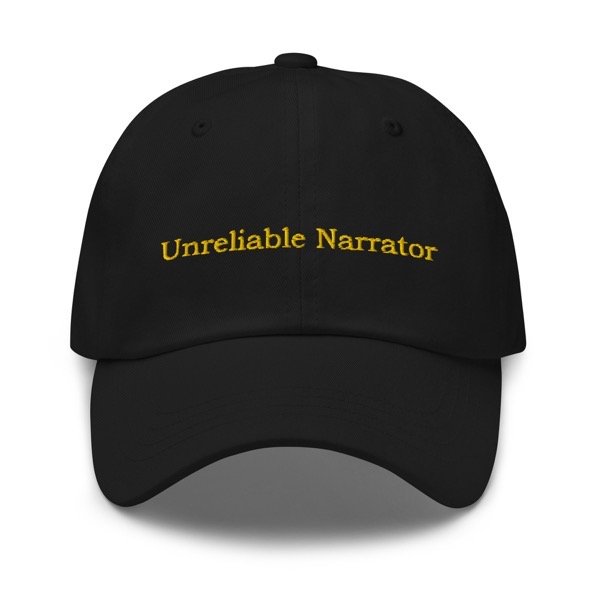
I am an unreliable narrator.
I make no pretense of disinterest. Everything I use to fill the vacuum of this life is done by choice. Consciously or subconsciously, I am neck-deep in my interests and biases. So are we all. The difference is my memory. It is eidetic. I can often remember things exactly as they happened. The trick to being unreliable is the interpretation of these events to suit the argument I am making, which may or may not remain consistent. It really depends on the moment. It depends on the audience. Now for the hard part. Sometimes I am the sole member of this audience.
And the cognitive dissonance that occurs during the process of packaging a situation is far more dissonant when the package is for self-consumption. It’s not impossible, clearly. And by what I’ve witnessed, I’m not the only person doing it. You see it in a color-by-numbers, kindergarten-simplicity when the law becomes involved. Statements are taken, snap judgments are made, then all evidence that fits a hypothesis is hoarded, while anything that subverts the accepted idea of “what happened” is summarily dismissed as coincidence or superfluous. In our personal lives, we do this shit on a whole other level. Why? Because we are fighting for our perceived actualization and the definition of our capital-S Self. That is a constant battle waged from cradle to grave, and everything is sacrificed in its effort.
The few individuals who can subvert this compulsion, or rise above it, are pointed to as heroes and anomalies of selfless wonder. Again, I don’t include myself, even remotely, among these beautiful freaks of human nature.